Taking the time to meet with your MP is a powerful way to show them that you care passionately about school funding, and will encourage your MP to think deeply about how this issue impacts their constituents.
Engaging with your MP can be incredibly impactful and effective. The Chancellor listens to what MPs say, and will take notice if MPs are feeling under pressure from their constituents. Writing to your MP also allows you to educate them—enabling them to learn more about the issue and understanding how strongly their constituents feel about it.
Your MP will have political access and tools to influence Chancellor Rachel Reeves — they can write to the Chancellor, ask questions in parliament, speak up in debates, table a motion, and propose changes to bills. If they know that their constituents feel passionately about school funding and pushing back against these cuts, they’ll apply more pressure on the Chancellor to reverse her decision.
There are a few ways you can engage with your MP:
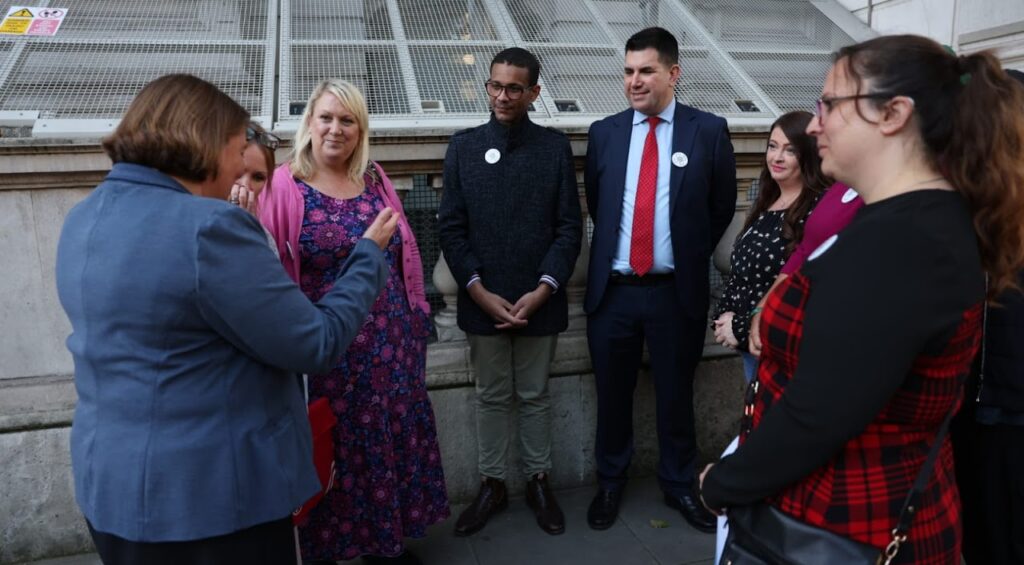
Open letter to the MPs in your town
By getting prominent members of your local community to sign an open letter to the MPs in your town, you’ll be letting them know how strongly their constituents feel about reversing the new cuts.
You can organise your community to sign the open letter that asks the MPs to stand against the cuts put forward by the Chancellor. Here’s our step-by-step guide to do that:
1. Gathering a team
Building a core team is one of the most important parts of this process.
Your team will help you draft your letter, conduct outreach and publish the document. The more representative and diverse your team can be, the stronger your engagement will be.
Your team might include a headteacher, parent, teacher and support staff. Consider representation across gender, age, race, ethnicity, and disability.
Having a headteacher on your team will give your letter strength and legitimacy. Heads are tasked with managing the budget for their school, and are often the most exposed and aware of the challenges faced as a result of Government cuts over the past 14 years.
2. Draft your letter
Here’s your chance to draft a letter to your MPs.
It’s an opportunity for you to share your experiences with school funding cuts; the impact that it’s had on your life or the lives of children, teachers, staff and parents from your school; and your hopes for the future.
You’ll want to get this published as an op-ed, so here are some tips and suggestions:
Aim to make it roughly 500-800 words in length.
Use a combination of storytelling, personal experiences, and facts about funding
Capture readers with a compelling first sentence, or open with a story
Use statistics, but put the figures in understandable terms for your readers. You can use numbers from schoolcuts.org.uk
Use local examples from your community, as that will resonate most with your readers
Some suggestions for things you can include:
Why reversing school cuts is important to you and your community
Your own observations and experiences with school cuts over the past fourteen years
The funding challenges that school staff and pupils face in your constituency
What restoring school funding would mean for your school or your family
Make sure you also list all the MPs for your town. To check the MPs for your town, use the Find your MP tool.
3. Conduct outreach for signatures
After drafting a powerful letter, you can move onto reaching out to prominent people in your community who can sign onto it. Try to get at least 10 people to sign onto it – and it’s great if you can find more!
With your team, make a list of people and organisations that you’ll reach out to, and assign who will reach out to them. Organisations and groups you could consider approaching include:
Heads and teachers in your local schools
- Local councillors
- Local businesses
- Local branches of trade unions:
- NEU
- NAHT
- ASCL
Sports centres or clubs
Faith leaders and organisations
Charities and service delivery organisations
4. Power up your action: publish and distribute
Fill out this form or click the button below to send us your open letter and contact information. We’ll send you:
- MP packages of the letter and Stop School Cuts resources that you can send to your MPs
- A digital action link that will make it easier for the general public to co-sign your letter.
- A designed and printed version of your open letter, so you can hang it up in your community
Now that you have your open letter and your signatories, it’s time to publish your letter. You can do this by:
- Media outlets: Sending it to local newspapers and online publications to publish as an op-ed. You’ll want to find the op-ed editor of the paper and send them a pitch email with your open letter.
- Community spaces: Printing your open letter and posting it in community spaces and public areas
- Social media: Share the letter on your social media or blog platforms and encourage others to share it
Make sure you also include a way for people to co-sign the letter if they read it through the paper or on social media. Let us know when you’re ready and we can help you produce supporting materials [email protected].
5. Send the letter to your MP
Finally: send the open letter to your MP
Once you’ve collected signatures, send your MP package to your MPs. Include the updated number of co-signees by printing a list.
Send them a physical copy of the letter at:
[MP name]
House of Commons, London SW1A 0AA.
You can also send your MP a digital version. Do that by finding the email addresses of your MPs here.
Meeting with your MPs
Taking the time to meet with your MP is a powerful way to show them that you care passionately about school funding, and will encourage your MP to think deeply about how this issue impacts their constituents.
Here is what you can do to meet with your MP:

👉 Arranging a meeting(click to expand)
You could arrange a formal meeting with the MPs that represent your town or area or just focus on the MP that represents your school community. It depends on your town and who you have involved. If you would like support on this email [email protected].
The best way to do this is to contact them, either by phone or email. As you might imagine, MPs receive a very large amount of emails and phone calls, so it may take a few weeks to hear back from your MP’s office. Feel free to follow up with them if you haven’t heard from them, either by email or by phone.
Because you are contacting several MPs, you might want to divide up the responsibility of scheduling and meeting the MPs between your team members.
Find out how to contact your MP
Most meetings will last 15-30 minutes. Decide where you would like to meet your MP. We recommend the following:
- At their constituency office
- At one of their advice surgeries (most MPs hold these at least once a month, in local places in your constituency. You can find your MP’s surgery times on their website or by calling the constituency office.)
- Meet your MP on a trip to Parliament (this is best done with your pupils, if you are a teacher)
- By inviting them to your school
As a note, Fridays are usually the best day to meet your MP in your constituency. Parliament rarely sits on a Friday and MPs will usually spend the day in their constituency, holding their drop-in surgery, attending events, and meeting constituents.
We have prepared templates to help you in the process. Click on any of the below to read more:
✉️ Template letter to request a meeting
Dear [MP name],
My name is [name], and I am a [profession] in your constituency. Along with [number of members of your delegation] others, I would like to request a meeting with you at [location]. I am available on [available dates], but can also be flexible to your schedule.
I am writing to you out of great concern for the future of our schools.
[If you have done work on an open letter, you can include that information here.] We wrote an open letter signed by [ABC] people in our community, asking you to take action.
We would like to share our stories as [headteachers, parents, teachers, etc], and hear your thoughts on school funding.
Do let me know when you would be available.
Best,
[name]
☎️ Phone script to request a meeting
Hello,
My name is [name], and I am a [profession] in your constituency. Along with [number of members of your delegation] others, I would like to request a meeting with you at [location]. I am available on [available dates], but can also be flexible to your schedule.
I would like to discuss school funding.
I’d like to share my story as a [role], and hear your thoughts on school funding.
Would you be willing to meet with me?
🏫 Template email to invite them to your school
Dear [MP name],
My name is [name], and I am a [profession] at [school] in your constituency.
I would love to invite you to our school to speak with our staff and students. We are available on [available dates], but can also be flexible to your schedule.
I’d like to share my story as a [role] at [school], hear your thoughts on school funding, and discuss ways forward for schools to be properly funded.
Do let me know when you would be available.
Best,
[name].
👉 Preparing for your meeting (click to expand)
It’s important to set the right expectations for your meeting. Make sure you take the steps below to prepare:
Your MP isn’t likely to commit to your delegation’s ask immediately during your meeting — but it’s still valuable to push them in the right direction, and inform them about what this decision would mean for their constituents. And the more that they feel this pressure, the more they’ll feel motivated to act.
Research your MP.
Learn more about their background. What motivates them? Do they have a background in education? What were their election commitments?
Decide who’s attending the meeting.
It might be more effective if you bring a small team with you. Your team might include a headteacher, parent, teacher and support staff. Consider representation across gender, age, race, ethnicity, and disability.
Prepare an agenda.
It might be helpful to plan 3 messages you want to land. For example, this might include sharing your group’s personal experiences, sharing numbers from schoolcuts.org.uk, and expressing what you want your MP to do about it.
Prepare your materials.
Make sure you bring the MP pack that we send you, and look up your school and/or community’s statistics on schoolcuts.org.uk. Bring notes on paper or on a phone app, if it’s helpful. If your community has an open letter to your MP, print it and bring it to the meeting.
Do a practice run with your team.
Make sure you:
- Share your personal stories
- Are concise
- Make a clear request
Let us know how it went
You can ask for support at any point using the WhatsApp community or through the campaign inbox: [email protected]. Let us know how you get on.