Stop School Cuts x Tax Justice UK
In July 2026, Stop School Cuts hosted a workshop with Tax Justice UK to ask where the Government could find the funding to restore the £4.5 billion that has been stripped from school budgets since 2010. We break down how they see the school funding crisis:
Teachers burnt out. Whole subjects scrapped from curriculums. Billions lost from school budgets. And the cuts keep coming.
The crisis in our schools is not inevitable – it’s a political choice.
And that means the Government can make different choices. So what’s standing in the way?
Tax Justice UK’s workshop made the answer clear: tax-avoiders and the ultra-wealthy.
While educators are paying for essential materials out of pocket and school leaders are losing sleep over how to stay out of the red, the wealthiest in our society are not paying their fair share.
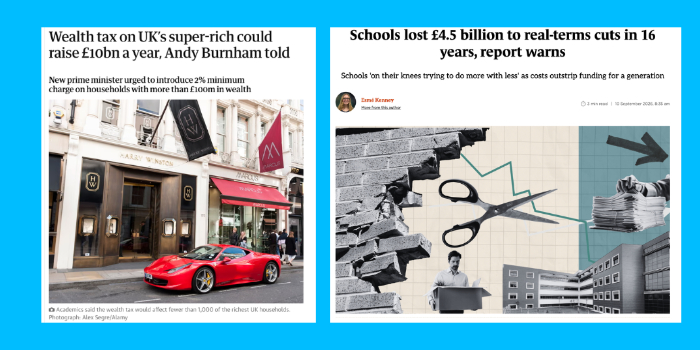
What’s the connection between school cuts and the ultra-wealthy?
As Caitlyn Boswell highlighted in a training with School Cuts activists, unfair loopholes and far lower rates of tax on income from wealth than work mean that the wealthiest in our society often pay proportionally lower taxes than the average person.
While living standards in the UK decrease, the wealth of the super rich grows at pace.
The UK’s 50 richest families now hold more wealth than the poorest half of the population (34 million people).
So what’s the way out?
Here’s two ideas, costed and tested by economists at Tax Justice UK, and supported by the National Education Union:
1. Demand the Government tax wealth, not work
At the moment, profits are taxed at lower rates than wages and salaries, meaning people’s hard work is taxed more than the assets of the ultra-wealthy.
A 2% wealth tax on those with assets over £10 million would raise upwards of £24 billion a year. This would only impact the richest 0.03% of the UK population, and give a lifeline to austerity-hit schools and other public services.
2. Demand the Government reform capital gains tax
Capital Gains Tax (CGT) is paid on profits made on the sale of an asset. The UK has the lowest CGT rate in the G7, with a lower CGT rate than income tax, allowing the ultra-wealthy to exploit loopholes and avoid paying their fair share.
Bringing the CGT rate in line with other nations – and implementing an exit tax for the ultra-wealthy threatening to move assets abroad – would raise upwards of £12 billion annually. Closing tax loopholes would open up funding for schools: climate-adaptations for classrooms, fully-funded pay increases for teachers, and supportive environments for every child to learn at their best.
Closing CGT loopholes and implementing a 2% wealth tax on the ultra-wealthy would raise five times the amount needed to restore school funding to 2010 levels. A pledge to stop school cuts is a commitment to proper for all public services.
Whenever you encounter a question about locating this funding, you’ve now got an answer.
The solutions are out there. What’s missing is the political will to make them happen.
That’s where we come in. In this critical time for our schools and all our public services, every action counts.
Will you ask your MP to pledge to reverse cuts to school funding?
As the crisis in our schools only gets worse, our resolution for a solution only gets stronger. Our current tax system disadvantages working people and lets public services crumble, but together we can work towards a system which ensures that everyone pays their fair share.
If you want to learn more how tax reform would transform our country, you can explore our resources and get involved at: https://taxjustice.uk/
To read more about the impact of reforms to taxation on education, you can read the National Education Union and Tax Justice UK’s joint policy briefing here: https://neu.org.uk/sites/default/files/2025-06/NEU3960%20Fund%20Fair%20Pay%20briefing%20v6.pdf